
Archive Record
Images
Metadata
Object ID |
2009.2093.20 |
Title |
History of Chevy Chase Elementary School |
Object Name |
Presentation |
Date |
May 11,1999 |
Creator |
Bridget Hartman |
Description |
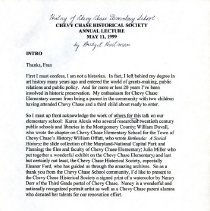
History of Chevy Chase Elementary School CHEVY CHASE HISTORICAL SOCIETY ANNUAL LECTURE MAY 11,1999 INTRO Thanks, Fran First I must confess, I am not a historian. In fact, I left behind my degree in art history many years ago and entered the world of grants-making, public relations and public policy. And for more or less 20 years I've been involved in historic preservation. My enthusiasm for Chevy Chase Elementary comes from being a parent in the community with two children having attended Chevy Chase and a third child about ready to enter. So I must up front acknowledge the work of others for this talk on our elementary school: Karen Alexis who several researched twentieth century public schools and libraries in the Montgomery County; William Duvall, who wrote the chapter on Chevy Chase Elementary School for the Town of Chevy Chase's History; William Offutt, who wrote "Bethesda: A Social History;" the slide collection of the Maryland-National Capital Park and Planning;" the files and faculty of Chevy Chase Elementary Julia Miller who put together a wonderful exhibit on the Chevy Chase Elementary, and last but certainly not least, the Chevy Chase Historical Society, especially Eleanor Ford, who has guided us through the amazing archives. So as a thank you from the Chevy Chase School community, I'd like to present to the Chevy Chase Historical Society a signed print of a watercolor by Nancy Derr of the Third Grade portal of Chevy Chase. Nancy is a wonderful and nationally recognized portrait artist as well as a Chevy Chase parent alumna who donated her talents for our renovation effort. SLIDE ONE-Chevy Chase sign Orem Ketchem at a recent Chevy Chase Village meeting reflected on Chevy Chase: He said, "my daughters had the privilege of being educated by Rachel Kennedy. And I then had the privilege of helping Mrs. Kennedy's son attend Princeton. My daughters are very successful today and Mrs. Kennedy's son went on to become a prominent judge." A teacher at St. Alban's credits his sixth grade teacher at Chevy Chase Janice Kopp with inspiring him to go into teaching high school English. A neighbor of mine recently told me how her son learned to parallel park in the parking lot of Chevy Chase Elementary. Last week in a walk through the neighborhood, I bumped into a friend taking her daughter to her scout meeting in the school's auditorium. SLIDE THREE-Chevy Chase School Chevy Chase Elementary is a very special place-for more than 100 years has been much more than a 9 to 3 public school. Among its teachers, parents, and students relationships have developed that have extended far beyond a 15-minute parent-teacher conference. Within the greater Chevy Chase area, the school has served as an active center, hosting a variety of community activities. Part of the reason for this personal connection that families have with the school is I think that it is physically connected to the neighborhood. Located on Rosemary Circle west of Connecticut Avenue, Chevy Chase Elementary is situated on only 3.8 acres, the second smallest elementary school site in the county. Most elementary schools have about 17 acres. As a result, the school isn't divorced from the community by a Berlin Wall of surface parking as it is in many neighborhoods. My remarks tonight will focus mostly on the buildings themselves although occasionally I know I will lapse into mentioning some of the wonderful programs of the school. As Fran mentioned, Chevy Chase Elementary is slated for extensive renovations beginning in June of this year. We will re-open in September 2000. A 61,000 square foot modernization costing at least $6.8 million. The renovation committee has been working with Montgomery County Public School Officials for two years to develop a quality school both for our teachers and our community. SLIDE FOUR-Parking Lot on the Circle I think the school's renovation committee, drove Montgomery County Public Schools officials crazy at some of our early meetings. MCPS kept saying parking, parking, parking. SLIDE FIVE-Playground and we kept saying playgrounds, playgrounds, playgrounds. SLIDE SIX-Playground Equipment In the end, I'm happy to report that the playground won out over parking. SLIDE SEVEN-Bus on the Circle We will keep Rosemary Circle as our traditional bus pick up and drop off spot for those students that don't walk to Chevy Chase. SLIDE EIGHT-Chevy Chase Circle But we need to turn our attention to another Circle-Chevy Chase Circle to better understand the school's early history. As with so many aspects of how our community looks and functions today, Senator Francis Newlands and the Chevy Chase Land Company played an early and instrumental role. In the mid-1890s, most of the schools in Montgomery County were located up county. They were one and two-room schoolhouses. There was only one high school and that was in Rockville. Down county residents typically sent their children to schools in the District of Columbia. SLIDE NINE-Real Estate Office on the Circle But thanks in large measure to the involvement of the Land Company, Chevy Chase Maryland families began to have neighborhood educational options. The Land Company understood very early on the importance of a community school if it was to be successful in its real estate endeavors. In the mid/late 1890s, the Land Company donated its real estate offices on Chevy Chase Circle when it moved out to Chevy Chase Lake. All Saints Episcopal Church also held its Sunday afternoon services in the building until its church building was completed in 1901. It's interesting to note that Chevy Chase Elementary and All Saints continue to have a co-living arrangement. For many many years, All Saints All Day has provided child care to the community at Chevy Chase Elementary. It's also worth digressing here a bit to say that the Land Company was involved not only with Chevy Chase Elementary but many other nascent educational endeavors. It donated land for a permanent elementary school south of the Circle, known as the E.V. Brown School, leased the Chevy Chase Inn (site of the 4-H Center) to and then eventually it sold to the Chevy Chase College for Young Ladies, and Land Company owned-land also became the site of North Chevy Chase Elementary. SLIDE TEN-Bradley Lane School Even in the early days, adequate funding for public schools was difficult and demanded a coalition of parents, county officials, and the business community. This hasn't changed. Once again, the Chevy Chase Land Company provided a solution. It agreed to provide a house and fuel for a school if the County Board of Education would establish a school in Chevy Chase. The school system paid $2,200 in construction costs. Chevy Chase Elementary opened in a two-room building at 3905 Bradley Lane in 1898. The school was short-lived and closed in 1903 due to low enrollment. More than likely, its demise was due to the strength of DC schools such as E.V. Brown. The house is now a residence. It was the site of one of the Chevy Chase Historical Society's Spring Gala's several years ago. It is now the home of a family, one of whose children now attend Chevy Chase Elementary! By 1911 however the DC government announced that it would charge tuition for non-resident students. Shortly thereafter, it refused enrollment altogether to non-resident primary school children. The need for a permanent school in Chevy Chase, Maryland became more urgent. Dr. Ryan Devereux, a county school commissioner and Chevy Chase resident, led efforts to organize the parents and establish the county's first PTA, the Chevy Chase Home and School Association. Its first job was to establish a school-a Herculean task. And, I think I can safely say that the Chevy Chase Elementary PTA has never looked back. SLIDE ELEVEN-Delaware School In September 1912, two teachers and a principal welcomed 108 students at a rented the Cromwell house at 6812 Delaware Street. The school included up to grade eight. In October, the Sentinel newspaper reported: "The entire community, as well as trustees, is devoting considerable time and taking a great deal of interest in the school proposition, and it is fully expected that before long the Chevy Chase school will be pointed out as the model school of Montgomery County." Success came quickly and by the next year the building could not accommodate the growing student enrollment and it was not available for a second year. SLIDE TWELVE-Portables on Rosemary Street Again, the Home and School Association, the Chevy Chase Land Company, and school officials provided a creative solution. The members of the Home and School Association borrowed $5,000 on individual notes to fund the construction these four temporary wooden buildings on land owed by the Chevy Chase Land Company. These wooden portables were located on the south side of Rosemary Street across from the current school parking lot. Within four years, the notes were paid off through the rent money paid by the county. School opened with "four competent and qualified teachers" and included all grades including two years of high school. By 1915, Chevy Chase Elementary was listed in S.D. Caldwell's Directory of Bethesda District, Montgomery County, Maryland as "No.3-Grammar, located, temporarily, on Rosemary Street....This school accommodates seven grades averaging 19 pupils each and three high-school grades." SLIDE THIRTEEN-Thomas Fisher & Co. Map, Section 4 from 1909 In 1917, on land that served as part of the original water system for Chevy Chase, a permanent school building opened. Here on this Thomas Fisher & Co. may of Section 4 from 1909, you can see evidence of the pumping station and reservoir. Also note that at the time, Valley Place connected Rosemary Street and Meadow Lane. [Describe when Bradley Lane School was. Describe where Delaware Street School was. Describe where the Portables were.] SLIDE FOURTEEN-Valley Place School The county paid $20,000 to build the Valley Place school. It was a two-story, red brick building that fronted on Valley Place. The school also provided a dining room in the basement. Here is Elsie Irvine and her third grade class taken in 1924 and in her Oral History with the Chevy Chase Historical Society, Mrs. Irvine recalls "There was something interesting about that old building, you know, the old red brick building. There was a big center hall with a piano and the classes assembled for sing-alongs and plays... the front steps of the building make an excellent place for class pictures during early spring and fall.... And I always thought that Valley Place was the prettiest entrance. The Rosemary Street entrance was plainer on the front.... There was, of course, a lot of land around it." SLIDE FIFTEEN-Water Tower This picture, taken in 1927 from the water tower on Rosemary Circle looking east towards Connecticut Avenue, shows houses were gradually being built in and around the school. The school playground and what was once Valley Place can be seen in the picture. The Valley Place School was located just off the picture to the left. Several of us believe that the Valley Place School was probably located on what is now called the upper blacktop. The 130-foot water tower stood prominently on Rosemary Circle for almost 40 years until it was torn down in 1934. Stories abound of kids climbing the spiral staircase and then jumping off. SLIDE SIXTEEN-East Facade of the East Wing By 1930, enrollment was steadily increasing. A new 12-classroom, red-brick building was constructed fronting on Rosemary Street. This was to be one part of a three-part U-shaped complex designed by Howard Wright Cutler and intended to be built in the 1930s. SLIDE SEVENTEEN-East and South Facade of the West Wing Six years later Cutler completed an identical brick classroom building to the west of the 1930s building. The Valley Place School, which was never part of Cutler's larger plan for Chevy Chase, was demolished. This second building added nine additional classrooms and cost $103,000. Howard Wright Cutler shaped and defined the design of Montgomery County Public Schools from the 1920s through the mid-1940s. He was responsible for among others Clara Barton Elementary (now a day care center), B-CC, and Montgomery Blair. But I think that Chevy Chase Elementary must have been one of his most handsome complexes. SLIDE EIGHTEEN-1936 and 1930 Classrooms Cutler envisioned two symmetrically balanced identical brick classroom buildings. Each have a grand staircase, portals and lobby. Each consisted of a long interior hallway flanked by three classrooms on each side. Connecting these buildings Cutler designed a central building that housed the auditorium, gym, administrative offices, art, music, science. This building was never built. However, a wooden "Long Hall" as it became known eventually connected the two buildings. SLIDE NINETEEN-1936 Wing-Hillcrest View Cutler's original vision has been compromised by subsequent additions in the 1950s, 60s, and 70s. However, the 1936 wing remains largely in tact and combines the modern with the traditional. Here you can see his wonderful restrained Art Deco in his flat roof, flat walls and fenestration patterns. These large expanses of glass let in a tremendous amount of light and fresh air into the classrooms. SLIDE TWENTY-1930 Wing-Window Detail The geometric detailing on the panels between the first and second floors gives an otherwise planar facade depth and decoration. And its this geometric detailing and window treatment that the renovation committee is looking to repeat in new wings of the modernized building. SLIDE TWENTY-ONE -1936 Wing-South Portico Cutler's entrances however are classical in design-grand entrances, highly sculpted portals against a flat windowless facade. SLIDE TWENTY-TWO-1936 Wing-Detail SLIDE TWENTY-THREE-1936 Wing-Detail SLIDE TWENTY-FOUR-May Day One of my most favorite photographs of the school in the Historical Society's collection is that of the May Day ceremonies in the courtyard. The courtyard-which will be restored in the upcoming renovation-defined the 1930 and 1936 wings and the "Long Hall." The courtyard existed until the addition in the 1970s when it was enclosed to become the school's library. Graduation ceremonies were held in the courtyard. Several parents in the community have recalled wonderful outdoor musical concerts and drama performances. One person described antiphonal singing by the children at the second story levels into the courtyard where classmates listened to the music. Not only did it provide a formal outdoor educational space, but the courtyard provide a great deal of light and fresh air into the classrooms. We are looking forward to its restoration. The "Long Hall" had quite a history to it too. It's been said that children used to crawl underneath to write secret messages in its underside. One former student who used to be my kids' pediatrician told me that he would often get trouble for running down this un-insulated corridor and making the floors and windows rattle. The "Long Hall" was replaced by classrooms in the 1950s. It unfortunately is not being restored in the upcoming renovation. SLIDE TWENTY-FIVE-Creative Club Here we have the fourth, fifth, and sixth grade members of the Creative Club. It's taken on the steps from the Long Hall. The Creative Club was organized by a sixth grade teacher, Agnes Kain. They built scenery and scripted and rehearsed plays after school. The money raised from these student performances went to buy books for the library. No story of Chevy Chase would be complete without a mention of our library and Mrs. Edith Dinwoodey. When Mrs. Dinwoodey enrolled her first child at Chevy Chase Elementary in 1935 she volunteered to organize the school's library. She had just visited John Eaton Elementary School's library in Cleveland Park in District. She recalled walking into a "sunny room full of children and books." She went to the superintendent of schools. His response was "if you want to do it, you're going to have to do it yourself. And that she and hundreds of other parents did. Parents painted walls, scoured second-hand shops for furniture, made curtains, and raised money to buy books. In the spring of 1939, the Chevy Chase PTA opened the first public elementary school library in Montgomery County. It was not only the first for the county but served as a model for other schools across the country. And for the next 20 years, until MCPS created a "librarian position" in school budgets, parents staffed it every day during school hours and regularly donated books. SLIDE TWENTY-SIX-Playground South facade-AP Room By the early 1950s, enrollment had mushroomed as evidenced by the large number of children on the playground. Mothers were always volunteering for playground duty. Today we're still out there but I generally wear sneakers. The school was packed with kids. All the space in the school needed to be used for classrooms. Even the library was bumped to the basement next to the boiler room. SLIDE TWENTY-SEVEN-South facade-AP Room In 1958, a new front wing was added that included the auditorium and administrative offices on the first floor and classroom spaces above the administrative offices. SLIDE TWENTY-EIGHT- Encapsulated south facade It was in this renovation that the front entrance of the 1930's east wing was partially encapsulated. The Long Hall was torn down for classrooms. The U-shaped courtyard became a square. SLIDE TWENTY-NINE-South facade-AP Room By 1968, Chevy Chase Elementary's student population was exploding. There were 828 students from 487 families. Twenty-eight teacher in kindergarten through six, plus an additional 14 other specials teachers and administrative staff. Finally in December 1973, after many years of very vocal lobbying, Chevy Chase parents were successful in convincing local and state officials that the school was in need of a major renovation. The renovation cost more than $1 million. SLIDE THIRTY-East facade of the 1930's wing While the many good changes occurred. Several not so good changes happened in the 1974-75 renovation. The bulk of the 1930 wing was removed to become a gym. The 1936 wing was modified to accommodate open classroom teaching. SLIDE THIRTY-ONE-North facade of the school The courtyard was filled in for additional classrooms and an expanded library. Ironically, not long after these changes, the open classroom space was re-partitioned into individual classrooms. As a result many of the teaching spaces at Chevy Chase are without windows and suffer from poor air circulation. Unlike this renovation where all the students will go to a single school-the old Radnor Elementary, in 1974, students went to seven neighboring elementary schools. Each grade, teachers and all (kindergarten through 6th) went to a different school! So Martine Glynn moved with her 2nd grade class to Westbrook. Janice Kopp moved with her 6th grade class to Burning Tree. SLIDE THIRTY-TWO-1936 Portal And that brings us to 1999. For more than a century, Chevy Chase Elementary has demonstrated educational leadership in the county. In 1912, citizens of Chevy Chase organized the first parent-teacher association. In the 1930s, it became the first county elementary school to open a school library, now so much a vital part of elementary school learning that it is hard to imagine a time without such a space. Educational professionals from all over the United States visited the Chevy Chase library when it opened. In the 1970s, the school was the first to introduce computers into elementary school curriculum. Also during that time, Chevy Chase opened up the first communications studio in elementary schools. Today, the studio is an integral part of the core curriculum at Chevy Chase. Its chorus has sung at Carnegie Hall, in Moscow, at the Kennedy Center and at the Bells of Hope Inauguration. Its instrumental music program boasts more than 200 students. Mrs. Marley's fifth grade plays are legendary. The school, its programs, its teachers, and its students have received local, state, and national recognition. Most recent accolades include the winner of the U.S. Department of Education Blue Ribbon School of Excellence and the winner of Redbook Magazine's Best Public School in the State. When parents, community members, faculty, Wiencek and Zavos, our architects, and school officials first met to begin planning for the renovation at Chevy Chase over a year ago, our goal was two-fold to build the best teaching spaces for our children and to give our community a neighborhood-friendly building befitting its rich past. Our plans for our new school a great. We took our clues from the Howard Culter's design of the 1930s. We are restoring the courtyard. Our auditorium will now connect with this courtyard. We've designed windows in the new sections of the school to match the expansive and operable windows in Culter's 1930 and 1936 wings. All classrooms will enjoy fresh air and natural light. We've giving prominence to our library by locating it in the front of the school to face Rosemary Street. As our June renovation draws near, the Chevy Chase community- businesses including a generous gift from the Chevy Chase Land Company, local governments, and individuals-have joined together to ensure the continuation of our century old Blue Ribbon School. That's about all I have to say. Thank you very much for asking me to speak about Chevy Chase Elementary. And again I can't thank the Chevy Chase Historical Society enough for everything its done to teach us about the history of our wonderful school. |